





How to Safely Dispose of Isopropanol (Isopropyl Alcohol): Environmental and Safety Guidelines
Disposing of isopropanol responsibly is critical to environmental stewardship, workplace safety, and regulatory compliance. This widely used solvent appears in laboratories, industrial operations, cleaning formulations, disinfectant products, and manufacturing processes, making proper disposal knowledge essential for professionals across numerous industries.
Isopropanol disposal poses significant challenges due to its high flammability, potential to form peroxides, and classification as hazardous waste. Learning appropriate disposal techniques protects workers from fire hazards and chemical exposure while ensuring compliance with strict regulatory frameworks.
This guide examines isopropanol disposal essentials, addressing regulatory obligations, fire safety measures, peroxide hazard management, and disposal options appropriate for different concentrations and operational settings.


In this article, we’ll review:
1. Why Proper Disposal Matters
2. How to Dispose of Isopropanol
3. Special Considerations for Isopropanol
Why Proper Disposal Matters
Isopropanol disposal carries serious implications that reach beyond standard waste handling. Understanding these consequences clarifies why regulatory agencies and facilities have developed specific protocols for managing this flammable solvent.
Environmental Protection
Environmental damage from isopropanol happens when disposal practices ignore the compound's behavior in natural systems:
-
Although isopropanol breaks down readily through biological processes, it exhibits high biochemical oxygen demand (BOD) that can cause oxygen depletion in aquatic systems when released in significant quantities. This oxygen consumption stresses fish populations and other aquatic organisms.
-
Improper disposal that allows isopropanol to reach waterways depletes dissolved oxygen levels as microorganisms metabolize the compound. This depletion creates conditions harmful to sensitive aquatic species during the degradation cycle.
-
Isopropanol can form explosive peroxides upon prolonged exposure to air, making improper storage and disposal of aged material both an environmental and a safety concern. Peroxide-contaminated isopropanol presents additional hazards beyond those of fresh material.
-
Appropriate disposal prevents these environmental impacts and supports responsible chemical management that protects ecosystem health.
Health & Safety
Human health and safety concerns make isopropanol disposal a workplace priority:
-
Isopropanol is highly flammable with a flashpoint of 12°C (53°F) and produces vapors heavier than air that can travel to distant ignition sources, creating severe fire and explosion dangers during handling and disposal.
-
The compound is toxic if ingested, causing central nervous system depression, kidney damage, and potential blindness. Workers must avoid accidental ingestion or contamination of food and beverages.
-
Vapors irritate eyes and respiratory passages. Inhalation can cause drowsiness, dizziness, and narcotic effects at elevated concentrations, impairing judgment and coordination.
-
Direct contact irritates skin, and prolonged exposure leads to drying and dermatitis. Eye contact causes serious irritation requiring immediate medical attention.
-
Workers handling isopropanol for disposal face hazards from fire, vapor inhalation, dermal absorption, and ingestion risks. Establishing proper disposal procedures with suitable protective equipment is essential for preventing exposure incidents.
Legal Compliance
The regulatory structure governing isopropanol disposal creates enforceable responsibilities:
-
Isopropanol is classified as D001 ignitable hazardous waste under the Resource Conservation and Recovery Act (RCRA) when discarded, requiring management through hazardous waste disposal programs. Facilities cannot legally eliminate it through regular trash or drain systems.
-
As a flammable liquid, isopropanol cannot enter public sewer systems. Municipal wastewater treatment plants cannot safely process flammable solvents due to fire and explosion risks in the collection infrastructure.
-
Transporting isopropanol waste is regulated as UN1219 ISOPROPANOL, Hazard Class 3, requiring proper documentation, labeling, and handling during shipment to disposal sites. Packing Group designation (II or III) depends on concentration.
-
Isopropanol is listed under SARA Section 313 for toxic chemical release reporting, requiring facilities meeting threshold quantities to report releases and waste management activities.
-
Operations generating isopropanol waste may need permits for hazardous waste storage and disposal, depending on monthly generation amounts. Generator status determines specific compliance requirements.
-
Violations bring substantial penalties, including fines, corrective action orders, and potential criminal liability. Compliance costs significantly less than enforcement actions and remediation expenses.
How to Dispose of Isopropanol
Effective isopropanol disposal starts with understanding your specific waste characteristics and connecting them to appropriate disposal methods while meeting all regulatory requirements.
Check Applicable Regulations
Regulatory compliance research builds the foundation of any successful disposal plan.
Review EPA hazardous waste regulations under RCRA. Isopropanol is classified as D001 ignitable waste due to its flashpoint below 60°C (140°F), triggering hazardous waste management requirements.
Examine state and local hazardous waste regulations specifically for ignitable wastes and flammable liquids. Storage duration limits, labeling requirements, and disposal timing restrictions may vary between jurisdictions based on facility size and monthly waste generation rates.
Verify if your facility requires an EPA identification number for hazardous waste generators. All facilities that treat, store, or dispose of hazardous waste must obtain this number.
Determine your generator status based on monthly hazardous waste generation volumes. Conditionally exempt small quantity generators (less than 100 kg/month) face fewer requirements than small quantity generators (100 to 1,000 kg/month) or large quantity generators (over 1,000 kg/month).
Note that aqueous isopropanol solutions containing less than 24% alcohol may be exempt from D001 classification under RCRA regulations. Confirm with your state environmental agency before treating dilute solutions as non-hazardous waste, as this exemption applies only to naturally dilute solutions, not purposely diluted waste.
Review transportation requirements carefully, as isopropanol solutions are regulated as UN1219 ISOPROPANOL, Hazard Class 3. Pure or high-concentration (>50%) isopropanol is Packing Group II, while diluted solutions (such as 70% isopropanol) may be classified as Packing Group III. Verify proper classification before shipping.
Drain Disposal Considerations
Drain disposal of isopropanol is explicitly prohibited and creates serious hazards:
-
Isopropanol is classified as ignitable hazardous waste that cannot be discharged to sanitary sewer systems. The Clean Water Act prohibits the discharge of hazardous substances to municipal sewer systems.
-
The extreme flammability creates fire and explosion hazards in sewer collection systems. Vapors can accumulate in sewer lines, manholes, and lift stations, creating explosive atmospheres that endanger utility workers and the public.
-
Isopropanol exhibits high biochemical oxygen demand that can cause oxygen depletion in waterways, harming aquatic ecosystems even after the solvent passes through treatment facilities.
-
Local wastewater discharge regulations strictly prohibit flammable materials. Violations can result in substantial fines from both EPA and local sewer authorities, plus liability for any resulting fires, explosions, or treatment plant damage.
-
Even significant dilution does not eliminate the hazardous characteristics. Federal regulations explicitly prohibit dilution as a treatment method to avoid hazardous waste classification, and flammable liquids remain forbidden from sewer discharge without authorization from the receiving municipality.
Use Designated Waste Disposal Methods
Proper disposal pathways depend on waste quantity, concentration, regulatory classification, and generator status.
Small Quantities (Laboratories and Small Businesses): Collect isopropanol waste in approved flammable-rated containers made from compatible materials such as glass or high-density polyethylene (HDPE). Avoid metal containers that might generate static sparks.
Label containers clearly with a complete contents description, including "Isopropanol" or "Isopropyl Alcohol," concentration if known, and the accumulation start date. Include all applicable hazard warnings (Flammable Liquid, Health Hazard).
If isopropanol has been stored for an extended period, include a note on the waste label indicating the age of the material and whether it has been tested for peroxides. This information protects disposal workers from peroxide-related hazards.
Store labeled waste containers in approved flammable storage cabinets that meet NFPA and OSHA requirements. Locate cabinets in cool, dry, well-ventilated areas away from all ignition sources, including electrical panels, heating equipment, and direct sunlight.
Arrange pickup through licensed hazardous waste disposal contractors who hold proper permits for collecting and transporting flammable hazardous waste. Verify contractor credentials, including EPA identification number and good compliance history.
Industrial Quantities: Large-scale operations generating substantial volumes of isopropanol waste should establish relationships with bulk hazardous waste collection services that can handle drum quantities or bulk pickups.
Maintain detailed waste manifests for all shipments using the Uniform Hazardous Waste Manifest (EPA Form 8700-22). These manifests track waste from generation through final disposal, creating documentation that demonstrates compliance.
Keep disposal records, including signed manifest copies and disposal certificates, for a minimum of three years. Many states require longer retention periods, so verify local requirements.
Consider recycling or reclamation programs at permitted solvent recovery facilities as an alternative to disposal. Isopropanol may qualify for fuel blending programs or industrial solvent recovery operations if it meets facility specifications. Confirm recycling eligibility with your state environmental agency.
Follow Department of Transportation regulations for all waste shipments. Containers must display proper hazard labels showing Flammable Liquid with appropriate Packing Group designation, and facilities must provide shipping papers with complete hazardous materials information.
Laboratory and Institutional Waste: Research institutions, universities, and teaching laboratories should collect isopropanol through institutional hazardous waste programs managed by environmental health and safety departments.
Use laboratory waste containers provided by the institution, which are typically pre-labeled with hazard information and designed for flammable liquid waste. Never use food or beverage containers for chemical waste collection.
Label containers with waste type, chemical composition, principal hazards, accumulation start dates, and the names of responsible researchers or departments. If isopropanol has been stored for an extended period, note the age and whether peroxide testing has been conducted.
Maintain chemical waste logs that document waste generation, including dates, quantities, compositions, and responsible parties. These records support institutional compliance and provide documentation for regulatory inspections.
The ACS recommends annual peroxide testing for all stored isopropanol. Follow environmental health and safety protocols specific to your institution, which often exceed regulatory minimums to provide consistent standards across diverse chemicals.
Understanding Fire and Safety Hazards
Isopropanol creates extreme fire hazards requiring constant attention during waste handling and storage.
Isopropanol is highly flammable, classified as OSHA Flammability Class IB with a flashpoint of 12°C (53°F) and an autoignition temperature of 399°C (750°F). Ignition can occur at room temperature or below, making fire prevention critical.
Vapors are heavier than air with a vapor density of 2.07, meaning they travel along floors and through low areas to reach distant ignition sources. Once ignited, flames can flash back to the source container, potentially causing explosions.
The compound is sensitive to static electricity discharge, requiring proper grounding and bonding of all containers during transfer operations. Even small static sparks from ungrounded containers or plastic funnels can ignite vapors and trigger fires.
This requires strict ignition control measures, including elimination of open flames, smoking materials, hot surfaces, and sparking electrical equipment. Use explosion-proof electrical and ventilating equipment in areas where isopropanol vapors may accumulate.
Employ non-sparking tools made from brass, bronze, or other non-ferrous materials when handling isopropanol waste containers. Steel tools can create sparks through impact that ignite vapors.
Maintain ventilated storage areas that prevent vapor accumulation. Ensure fire suppression capabilities are readily available during all handling and disposal activities. Alcohol-resistant foam or dry chemical extinguishers are appropriate for isopropanol fires. Water spray or fog may be used for cooling, but straight streams of water are not effective on alcohol fires.
Understanding Peroxide Formation Hazard
Isopropanol is a Group B peroxide-forming chemical that presents unique disposal challenges.
The compound can react with atmospheric oxygen over time to form explosive peroxides, particularly when exposed to air, light, or heat. Peroxide concentrations become dangerously explosive if the material is concentrated through evaporation or distillation.
Do not distill or evaporate isopropanol without first testing for peroxides. These operations can concentrate peroxide compounds to explosive levels, creating extreme detonation hazards.
Store isopropanol in tightly sealed, amber or opaque containers away from light and heat. Transparent containers allow light exposure that accelerates peroxide formation, while heat increases reaction rates.
Test for peroxides annually (every 12 months) after receipt or dispose of as hazardous waste. Facilities should establish testing schedules that ensure all stored isopropanol undergoes peroxide evaluation before the 12-month threshold.
If crystals, wispiness, or stratification are observed in or around the container, do not open or move it. These visual indicators suggest peroxide formation has occurred. Contact your environmental health and safety office or licensed hazardous waste contractor immediately for specialized handling.
All isopropanol disposed of as waste should be labeled, noting whether it has been peroxide-tested and its approximate age. This information protects disposal workers who handle the material and allows them to implement appropriate safety measures.
Aged or improperly stored isopropanol may contain peroxides. If the material is older than 12 months, has been exposed to light, or shows visible discoloration, do not handle it without consulting your environmental health and safety office.
Never Mix Chemicals
Chemical compatibility concerns can transform routine disposal into dangerous situations.
Avoid mixing isopropanol with strong oxidizing agents, including hydrogen peroxide, chromium trioxide, potassium permanganate, and perchlorates. These combinations can cause violent exothermic reactions, spontaneous ignition, or explosive decomposition.
Never combine isopropanol with strong acids or strong bases, which can generate heat and potentially ignite the flammable solvent. Reactions with concentrated acids are particularly hazardous.
Keep isopropanol separate from amines, ammonia, and chlorine. These mixtures can produce toxic gases or undergo violent reactions.
Mixtures with hydrogen peroxide and certain peroxides can form compounds capable of detonation. Never combine isopropanol waste with oxidizer wastes or peroxide-containing materials.
Store waste containers with adequate separation from incompatible materials. Use dedicated flammable storage cabinets only for flammable solvents, never mixing flammables with oxidizers, acids, or reactive chemicals.
Mixed chemical wastes often require disposal as unidentified or incompatible waste mixtures, substantially increasing disposal costs. These mixtures create additional hazards for waste handlers who must manage unknown reaction potentials.
Follow PPE Guidelines
Worker protection during isopropanol disposal requires appropriate personal protective equipment:
-
Always wear chemical-resistant gloves (nitrile or neoprene) when handling isopropanol for disposal. These materials provide good resistance to isopropanol while maintaining dexterity.
-
Use safety goggles or full face shields to protect eyes from splashes during waste transfers, container handling, or spill cleanup. Isopropanol causes serious eye irritation requiring immediate flushing.
-
Wear flame-resistant protective clothing when handling flammable waste. Avoid synthetic fabrics that can melt when exposed to flames, creating severe burn injuries. Cotton or flame-resistant treated garments provide better protection.
-
Ensure adequate ventilation when transferring, consolidating, or handling isopropanol waste. Work in fume hoods, ventilated storage areas, or well-ventilated spaces to prevent vapor accumulation and reduce inhalation exposure.
-
Avoid breathing vapors that may cause respiratory irritation, drowsiness, dizziness, and narcotic effects at high concentrations. Use explosion-proof ventilation equipment where required to maintain air circulation.
-
Have eyewash stations and safety showers available and accessible within 10 seconds (approximately 100 feet) of areas where isopropanol is handled. Test emergency equipment regularly to ensure proper operation.
-
Keep all sources of ignition away from work areas. Post "No Smoking" and "Flammable Liquid" signs in storage and handling areas.
Special Considerations for Isopropanol
Isopropanol creates unique disposal considerations based on concentration-dependent classification, peroxide formation potential, and diverse applications.
Concentration-Dependent Classification
Isopropanol transport classification varies by concentration, affecting shipping requirements and costs.
Pure or high-concentration (>50%) isopropanol is classified as UN1219, Class 3, Packing Group II. This classification requires specific packaging, labeling, and placarding for shipments.
Diluted solutions, such as 70% isopropanol, may be classified as Packing Group III, which carries slightly less stringent transportation requirements. The lower packing group reflects reduced flammability hazards at lower concentrations.
Confirm proper classification before shipping waste to disposal facilities. Incorrect classification can result in shipment rejections, return freight charges, and regulatory violations.
Communicate complete concentration information to waste disposal contractors. Incomplete or inaccurate waste descriptions cause shipment problems and compliance issues.
Peroxide Testing Prior to Disposal
Aged or improperly stored isopropanol may contain peroxides requiring special handling precautions.
If the material is older than 12 months, has been exposed to light, or shows visible crystals or discoloration, do not handle it without consulting your environmental health and safety office. These conditions indicate potential peroxide formation.
Label waste containers to indicate whether the material has been tested for peroxides. Include testing dates and results if available. This information allows disposal contractors to implement appropriate safety measures.
Facilities should establish peroxide testing programs for stored isopropanol. Testing kits are commercially available and provide rapid results indicating peroxide presence and approximate concentrations.
Materials testing positive for peroxides require specialized disposal through contractors equipped to handle peroxide-contaminated solvents. Never attempt to distill, evaporate, or heat peroxide-contaminated isopropanol.
Laboratory and Research Settings
Universities and research institutions classify isopropanol as hazardous waste requiring collection through environmental health and safety programs with proper manifesting.
Academic institutions typically provide dedicated laboratory chemical waste collection programs with regular pickup schedules, pre-labeled containers, and comprehensive documentation support. Researchers should utilize these programs rather than attempting independent disposal arrangements.
Teaching laboratories generating isopropanol waste must follow the same hazardous waste requirements as research laboratories. Student-generated waste requires the same careful handling, labeling, and disposal as professional research waste.
The ACS recommends annual peroxide testing for all stored isopropanol in laboratory settings. Implement testing schedules that track receipt dates and ensure testing occurs before 12-month storage periods expire.
Research facilities must maintain documentation, including chemical waste logs, hazardous waste training records for all personnel handling waste, and emergency response procedures specific to flammable solvents.
Industrial Applications and Recycling Options
Large quantities may qualify for recycling through permitted solvent recovery facilities, providing environmentally preferable alternatives to disposal.
Recovered isopropanol can be used for fuel blending, where it serves as an oxygenate additive to gasoline, or industrial solvent applications after purification through distillation.
Confirm recycling eligibility with your state environmental agency. Some states offer regulatory exemptions for materials sent to legitimate recycling operations, potentially reducing management costs.
Contact specialty chemical reclaimers and fuel blenders to explore recycling options for your specific waste volume and purity. Provide complete composition information, including concentration, contamination status, and approximate quantities.
Recycling represents the most environmentally preferable option when available. Reclaimed solvents reduce demand for virgin production and divert waste from disposal facilities.
Household Quantities and Consumer Products
Even small consumer quantities, such as rubbing alcohol, cannot be disposed of down drains and should be taken to household hazardous waste collection facilities or events.
Household hazardous waste is exempt from federal hazardous waste regulations under the household hazardous waste exclusion, but still requires proper disposal through designated collection programs rather than regular refuse or sewers.
Consumer products containing isopropanol, such as rubbing alcohol, disinfectants, or specialty cleaners, should be taken to household hazardous waste collection programs when no longer wanted.
Contact your local solid waste authority, environmental health department, or county government to locate household hazardous waste collection programs in your area. Many communities offer quarterly or semi-annual collection events plus year-round drop-off options.
Never pour small quantities down drains, into storm sewers, or onto the ground. These disposal methods violate environmental regulations and create fire hazards, plus toxic contamination.
Emergency Spills and Response
Isopropanol spills create immediate fire hazards requiring rapid response focused on eliminating ignition sources and containing the release.
Eliminate all ignition sources immediately, including electrical equipment, open flames, smoking materials, hot surfaces, and potential static electricity sources. Turn off electrical power to the spill area if safe to do so.
Evacuate non-essential personnel from the spill area and restrict access. Ensure that responders use proper personal protective equipment, including chemical-resistant gloves, eye protection, and respiratory protection if vapor concentrations are high.
Contain spills using absorbent materials such as vermiculite, dry sand, fuller's earth, or commercial spill pads designed for flammable liquids. Avoid sawdust or other combustible absorbents that could ignite.
Ensure adequate ventilation in spill areas, as isopropanol vapors are heavier than air and accumulate in low areas, including basements, sumps, floor drains, and confined spaces. Use explosion-proof ventilation equipment or natural ventilation.
Collect absorbed material and place it in suitable flammable waste containers labeled for hazardous waste disposal. Contaminated absorbent materials are hazardous waste requiring disposal through the same channels as the original isopropanol.
Never attempt to wash spills into floor drains, sanitary sewers, or storm drains. This practice violates environmental regulations, creates fire hazards in drain systems, and may result in substantial fines plus cleanup costs.
Transportation Classification and Documentation
Isopropanol waste requires proper classification and documentation for all off-site transportation.
The Department of Transportation regulates isopropanol as UN1219 ISOPROPANOL (ISOPROPYL ALCOHOL), Hazard Class 3 (Flammable Liquid). Packing Group (II or III) depends on concentration and must be verified before shipment.
Containers being shipped must display proper hazard labels showing the Flammable Liquid symbol and the correct Packing Group designation. Labels must meet DOT size, color, and placement requirements for the container type.
Shipping papers (hazardous waste manifests) must include the proper shipping name, hazard class, UN number, packing group, and total quantity. Additional information includes EPA waste codes, generator identification number, and emergency contact information.
Vehicles transporting isopropanol waste in quantities requiring placarding must display DOT placards showing "Flammable Liquid" with the appropriate hazard class number.
The Uniform Hazardous Waste Manifest tracks waste from generation through final disposal. Generators must complete all required sections, obtain signatures from transporters and disposal facilities, and retain signed copies for three years minimum.
Documentation and Recordkeeping Requirements
Maintaining comprehensive records demonstrates regulatory compliance and provides documentation for inspections.
Keep copies of all hazardous waste manifests for a minimum of three years from the date waste was accepted by the initial transporter. Many states require longer retention periods, so verify local requirements.
Retain disposal certificates and notices from treatment, storage, and disposal facilities confirming proper waste handling. These documents prove the waste reached appropriate facilities and was managed according to regulations.
Maintain waste generation records, including quantities, compositions, classifications, and accumulation dates. These records support generator status determinations and demonstrate compliance with storage time limits.
Document employee training in hazardous waste management for all personnel who handle isopropanol waste. Training records should include dates, topics covered, trainer qualifications, and employee acknowledgments.
Keep safety data sheets for all isopropanol products used at your facility. SDS provides essential information for waste classification, emergency response, and worker protection.
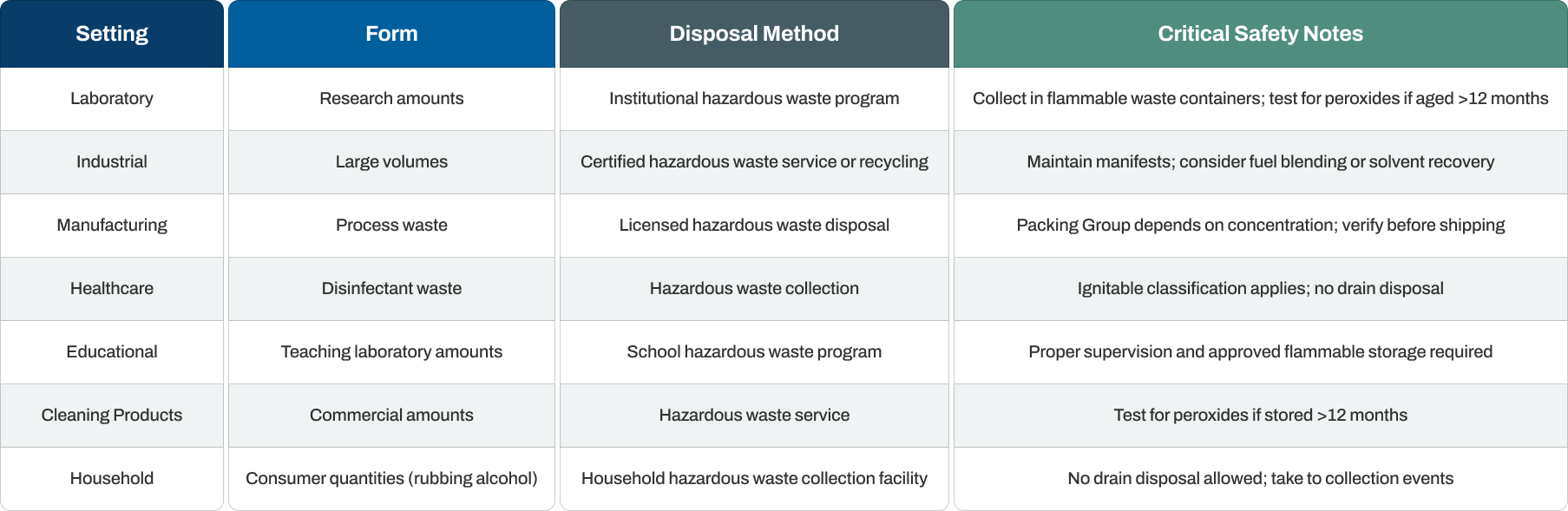
Quick Reference: Disposal Methods and Safety Requirements
Final Note
Isopropanol's classification as ignitable hazardous waste requires strict disposal protocols regardless of application, quantity, or concentration. Understanding federal RCRA requirements, peroxide formation hazards, using proper fire safety procedures, and maintaining appropriate protective equipment promote compliant, safe disposal operations.
For safe, regulatory-compliant disposal of isopropanol and expert guidance on peroxide testing and concentration-specific requirements, contact licensed hazardous waste management companies. Always consult current Safety Data Sheets (SDS) for specific handling and disposal information related to your particular isopropanol product and concentration, and follow all applicable institutional, company, federal, state, and local regulations for hazardous waste management.
When uncertain about disposal procedures, consult environmental health professionals, hazardous waste disposal specialists, or regulatory agency compliance assistance programs for guidance specific to your concentration, storage age, volume, and jurisdiction.
For more detailed guidance, explore our Resource Library
Our Customer Care team is also available for more information and documentation, including chemical Safety Data Sheets.
Need Isopropanol You Can Trust?
If you are looking for high-quality isopropanol for your lab, product line, or research facility, be sure to visit our store to explore our trusted selection and request a quote.
As your trusted partner in chemical supply, Lab Alley is always striving to meet the growing demands of our customers. We want you to be able to access all of your chemical needs in one place, along with streamlined online ordering and fast shipping.
Due to popular demand from our valued clientele, Lab Alley's isopropanol is available in a range of purities and packaging options to suit various commercial, laboratory, and personal needs.